 comparison
Fire Resistant Ceiling Materials for Homes Compared
Last Updated: November 2, 2026
Quick Summary
Fire resistant ceiling performance depends on the complete tested assembly, not the board or tile alone. Fire-rated plasterboard achieves high fire resistance in tested systems, while mineral-fibre tiles reach Class A2 to B and PVC planks are combustible. Always confirm the fire test evidence for the exact build-up you install.
- Reaction to fire and fire resistance are separate tests; a good Euroclass says nothing about fire-resistance minutes.
- Fire resistance is classified under BS EN 13501-2 in 30, 60, 90 or 120 minute periods.
- Fire-rated plasterboard typically costs £25-£45 per m² installed, with two layers common for 60 minutes.
- Mineral-fibre tiles are not moisture-tolerant, so avoid them in bathrooms or persistently damp rooms.
- Building Regulations require a fire-rated ceiling where it forms part of a fire-resisting separation, such as in flats and integral garages.
Table of Contents
- Fire Resistant Ceiling Materials for Homes: What Actually Matters
- Reaction to Fire vs Fire Resistance: Two Different Tests
- Fire Classifications and BS EN 13501-2 Explained
- Fire-Resistant Plasterboard and Gypsum Board Ceilings
- Fire-Rated Ceiling Tiles: Mineral Fibre, Metal and PVC
- Fire-Resistant Ceiling Insulation and the Full Assembly
- When Building Regulations Require a Fire-Rated Ceiling
- Request a Consultation Before You Choose a Ceiling
- Frequently Asked Questions
Fire Resistant Ceiling Materials for Homes: What Actually Matters
Fire resistant ceiling materials for homes are products and systems that slow the spread of flames and smoke overhead, buying occupants time to escape. The gap between a "fire-rated tile" and a genuinely fire-resistant ceiling catches people out constantly.
Here is the core problem. Most buyers shop for a material. They should be shopping for an assembly. A tile with a good fire classification screwed to ordinary timber battens is not a fire-rated ceiling.
Below, we break down the tests, the classifications, and the practical choices for a home. The first thing to understand is that two completely different fire tests get confused in almost every guide on this topic.
Reaction to Fire vs Fire Resistance: Two Different Tests
Reaction to fire describes how a material behaves when it is exposed to heat: whether it ignites, how fast flames spread, and how much smoke it produces. Fire resistance describes how long a complete ceiling assembly holds back fire.
That distinction decides everything. A plasterboard can have excellent reaction-to-fire results and still fail to protect a floor above if it is fixed to the wrong battens.
Think of it this way:
- Reaction to fire answers "what does this material do in a fire?"
- Fire resistance answers "how long does this ceiling stop a fire getting past it?"
For a homeowner, fire resistance is usually the number that matters, because it is what protects an escape route or a flat above. Reaction to fire matters most in circulation spaces and where materials cover large areas.
Fire Classifications and BS EN 13501-2 Explained
Fire classification in the UK follows the BS EN 13501 series, which uses Euroclass ratings from A1 to F. Class A1 means the material makes no meaningful contribution to fire; lower classes indicate increasing combustibility.
The Euroclass scale for reaction to fire runs from A1, A2, B, C, D, E down to F. Class A1 and A2 products are commonly described as non-combustible, though the formal definition is tighter than the marketing use of that term.
Fire resistance is classified separately under BS EN 13501-2, which expresses performance in minutes: 30, 60, 90 or 120.
Watch out: a product's Euroclass tells you nothing about its fire-resistance period. If you want to see how one ceiling material performs against both classifications in practice, our guide to 7 facts about stretch ceiling fire safety walks through the test evidence.
Fire-Resistant Plasterboard and Gypsum Board Ceilings
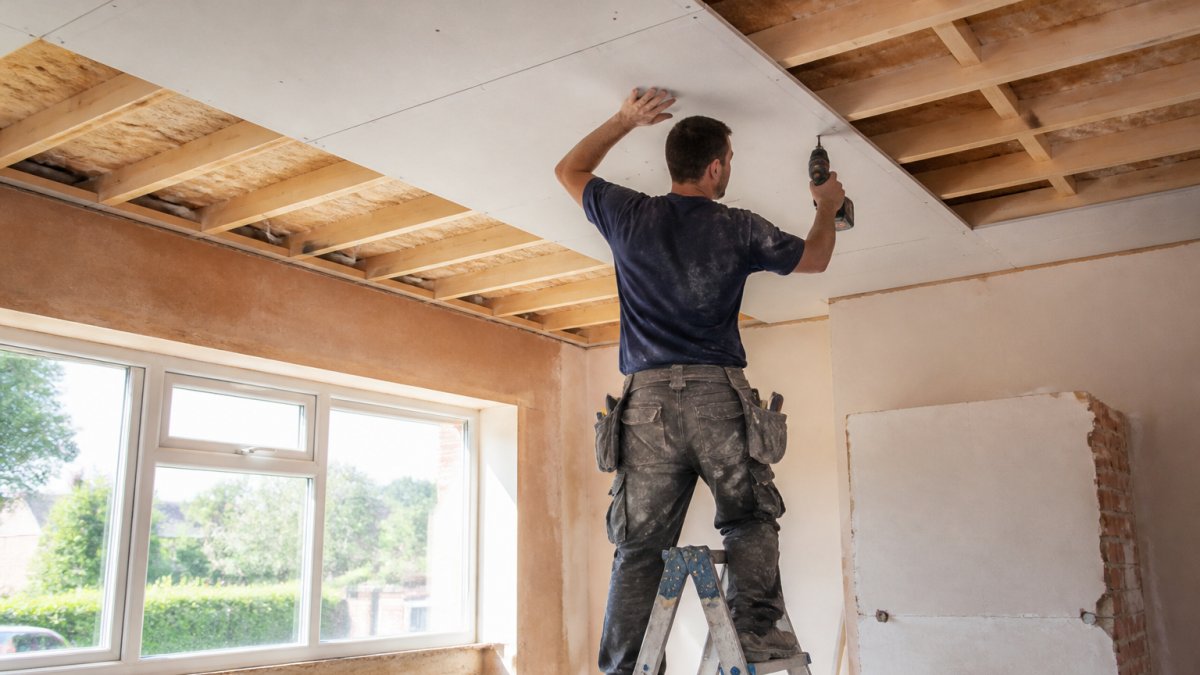
Fire-rated plasterboard, often called Type F or fire board, contains additives that keep the gypsum core intact for longer under heat.
Gypsum releases water when heated, which slows temperature rise on the far side. That property is why a well-built plasterboard ceiling can achieve a meaningful fire-resistance period, and why the fixing method matters as much as the board.
The practical points:
- Fire board only performs as part of a tested system, with specified fixings, joint treatment and batten spacing
- A single layer rarely achieves the higher ratings; two layers are common for 60 minutes
- Joints and service penetrations are the weak points, and they are where installations fail
Where a ceiling is sound but dated, covering it can be smarter than stripping it out. Our guide to covering Artex ceilings without plastering compares the realistic methods, and the stretch ceiling versus plastering cost comparison sets out how the two options differ on time and durability.
Fire-Rated Ceiling Tiles: Mineral Fibre, Metal and PVC
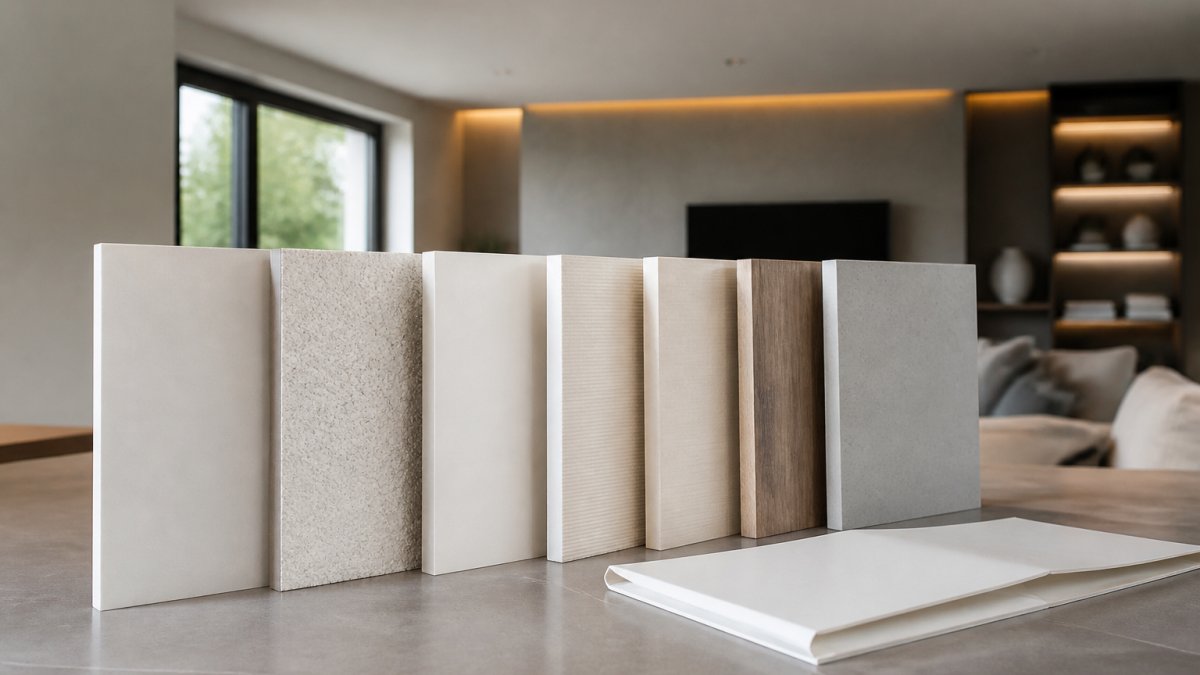
Fire-rated ceiling tiles divide into three families for domestic use: mineral fibre, metal, and PVC. Mineral fibre leads on fire performance, metal is durable and non-combustible, and PVC is the weakest of the three in fire terms. But fire performance alone is not how a homeowner should choose. The practical questions are what the ceiling will cost to install, how it will cope with moisture and noise, how easy it is to repair, and whether it suits the room above and below.
Mineral-fibre tiles are made from mineral wool and binders. Good versions reach Class A2 or B on reaction to fire and are widely used where a suspended ceiling is wanted.
Metal ceiling panels, typically aluminium or galvanised steel, are non-combustible as materials.
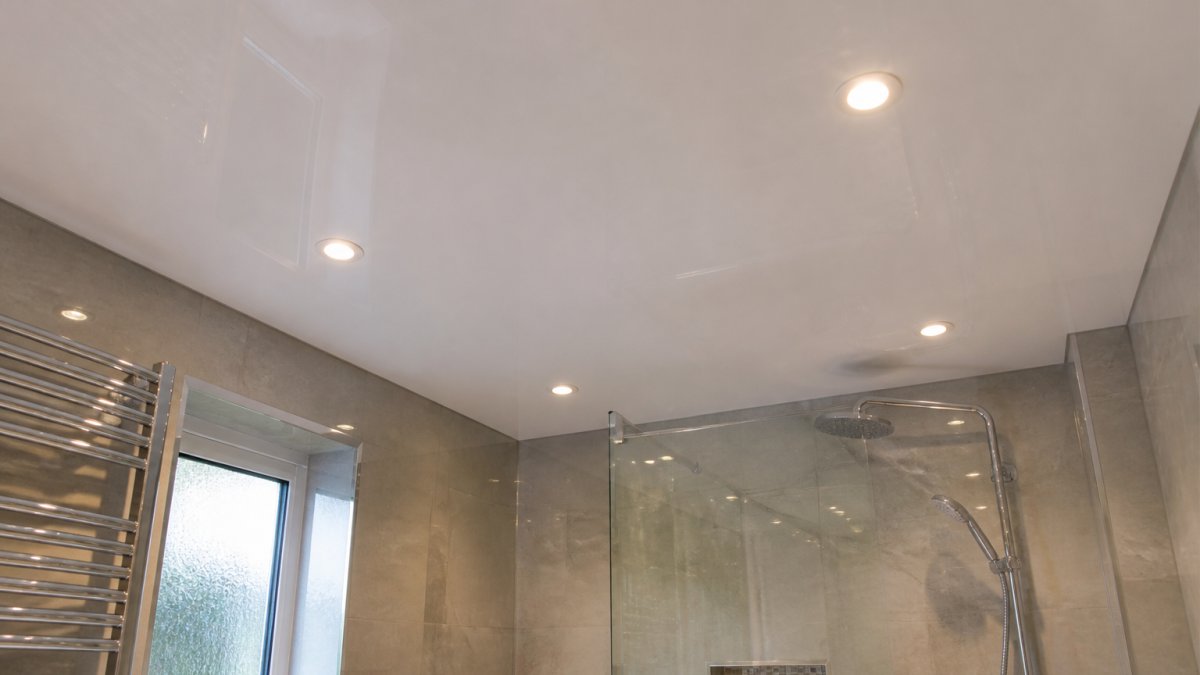
PVC ceiling planks are cheap and moisture-tolerant, which is why they turn up in bathrooms. They are combustible and produce dense smoke.
| Material | Reaction to fire | Fire-resistance potential | Indicative installed cost | Maintenance and repair | Best for |
|---|---|---|---|---|---|
| Fire-rated plasterboard | Class A2 to B | High, in tested systems | £25-£45 per m² | Replaster and redecorate; joints can crack | Most domestic ceilings |
| Mineral-fibre tiles | Class A2 to B | Moderate, system-dependent | £25-£55 per m² | Swap individual tiles; not moisture-tolerant | Suspended ceilings, acoustic rooms |
| Metal panels | Non-combustible material | Depends on assembly | £40-£70 per m² | Wipe-clean; dented panels hard to blend | Kitchens, utility spaces |
| PVC planks | Low | Low | £20-£40 per m² | Easy to clean; can discolour; hard to repair invisibly | Bathrooms, low-risk areas |
Pricing varies with access, ceiling height and the condition of the existing substrate; contact Stretcharama for a quote.
Best for: mineral fibre where a suspended grid suits the room and acoustic absorption is welcome. Skip if: the ceiling needs to be seamless, because a grid ceiling will not deliver that finish.
Fire-Resistant Ceiling Insulation and the Full Assembly
Fire-resistant ceiling insulation sits above or within the ceiling and works with the boards to complete the assembly. The insulation is rarely the deciding factor on its own; the tested combination is.
Mineral wool is the usual choice. It is non-combustible, stays in place when correctly fitted, and adds acoustic benefit alongside thermal performance. The mistake is assuming that adding insulation improves fire resistance. In some tested systems it does; in others it changes the assembly enough to invalidate the rating.
That is the part most guides miss. A ceiling assembly is a package: boards, fixings, battens, insulation, joints and any penetrations, all specified together and tested together. Change one element and you need to check the test evidence again.
For practical purposes:
- Ask for the fire test report or classification document for the exact build-up, not just the board
- Check that the fixing schedule matches what was tested
- Keep service penetrations to the tested details, or have them properly sealed
When Building Regulations Require a Fire-Rated Ceiling
Building Regulations require a fire-rated ceiling where the ceiling forms part of a fire-resisting separation. In a single dwelling, ordinary room ceilings are rarely required to provide fire resistance. The situations that catch homeowners out are the ones where the ceiling is doing a job it was never asked to do when the house was built.
The relevant guidance sits in Approved Document B, which sets out the fire safety requirements for dwellings and flats. The detail depends on the building type, the number of storeys and what sits above or below the ceiling. The contexts where a fire-rated ceiling is most commonly required in a home are:
- Flats and maisonettes. The ceiling between a flat and the common corridor, or between flats, is usually a fire-resisting separation. Replacing or covering it without maintaining that resistance is a compliance problem.
- Conversions. Converting a loft, garage or basement into habitable space often brings the ceiling into scope, particularly where a new room sits above a protected escape route or adjacent to another dwelling.
- Integral garages. A ceiling separating a garage from the house above or beside it is typically required to resist fire, because the garage is a higher-risk space.
- Protected escape routes. Where a ceiling forms the underside of a route from a habitable room to an exit, it may need to provide fire resistance to protect that route.
- Two-storey extensions and significant alterations. Where work is notifiable, building control will confirm whether the existing ceiling must be upgraded to maintain the fire strategy of the house.
Two points homeowners get wrong:
- Replacing a ceiling in a flat or a garage separation without maintaining the fire resistance is a compliance problem, not just a cosmetic one. The ceiling may look better and perform worse.
- Stretch and suspended ceilings can be installed over an existing fire-rated ceiling, but they must not compromise it, and any penetrations must be handled correctly. A downlight cut through a fire-rated board without a properly rated cover or seal is a hole in the separation.
If you are unsure which category your ceiling falls into, treat it as a fire separation until someone qualified confirms otherwise. The correct route is to check the approved document and, where work is notifiable, confirm with building control before work starts.
Request a Consultation Before You Choose a Ceiling
Choosing a ceiling material is a fire decision first and a design decision second. Get the assembly right, then choose the finish you actually want to look at.
That is where we come in. Stretcharama installs stretch ceilings that cover cracked, stained or dated Artex surfaces without plaster dust and without disruption.
If you want to understand the product before committing, read what a stretch ceiling is and whether it is right for your home. When you are ready, tell us about the ceiling your home deserves and we will arrange a consultation.
Frequently Asked Questions
What is the most fire-resistant material for a ceiling?
No single material wins outright, because performance depends on the complete ceiling assembly rather than the board or tile alone. Gypsum-based fire-resistant plasterboard and mineral-fibre tiles both achieve strong Euroclass ratings and can form part of a tested system with a stated fire-resistance period in minutes. Metal panels are non-combustible but conduct heat. The decisive factor is whether the assembly has been tested to BS EN 13501-2 as a system and carries the minutes rating your project needs.
Are PVC ceilings fire-resistant?
PVC ceiling planks and PVC-faced tiles are combustible and typically achieve a lower reaction-to-fire classification than gypsum or mineral fibre. They can still be sold as fire-rated when combined with specific components, but you should ask for the classification report rather than the marketing label. In escape routes and kitchens, a non-combustible or Class A1 to B material is usually the safer specification. Check the product's declaration against BS EN 13501-1 before committing.
Does fire-resistant plasterboard make a ceiling fireproof?
No material makes a ceiling fireproof. Fire-resistant plasterboard slows the spread of fire and can give a stated fire-resistance period, often expressed in minutes, when installed as part of a tested assembly with the correct fixings, joints and insulation. A single layer fitted incorrectly, or a board swapped for a different thickness, can void that performance. Keep the manufacturer's system documentation and match every component to it.
How can I check a ceiling material's fire rating?
Ask for the classification report citing BS EN 13501-1 for reaction to fire and BS EN 13501-2 for fire resistance, plus the test standard the assembly was assessed against. Look for the Euroclass (A1, A2, B and so on) and any minutes rating, and confirm the report covers the exact build-up you plan to install. Independent third-party certification adds confidence. If a supplier cannot produce documents for the full system, treat the claim as unverified.
Fire performance is not a detail you can retrofit cheaply once the ceiling is up. If your ceiling is cracked, stained or dated, get the specification right before the finish goes on. Get started with Stretcharama and book a consultation to find a ceiling solution that covers the problem, meets the requirement and looks right for the room.